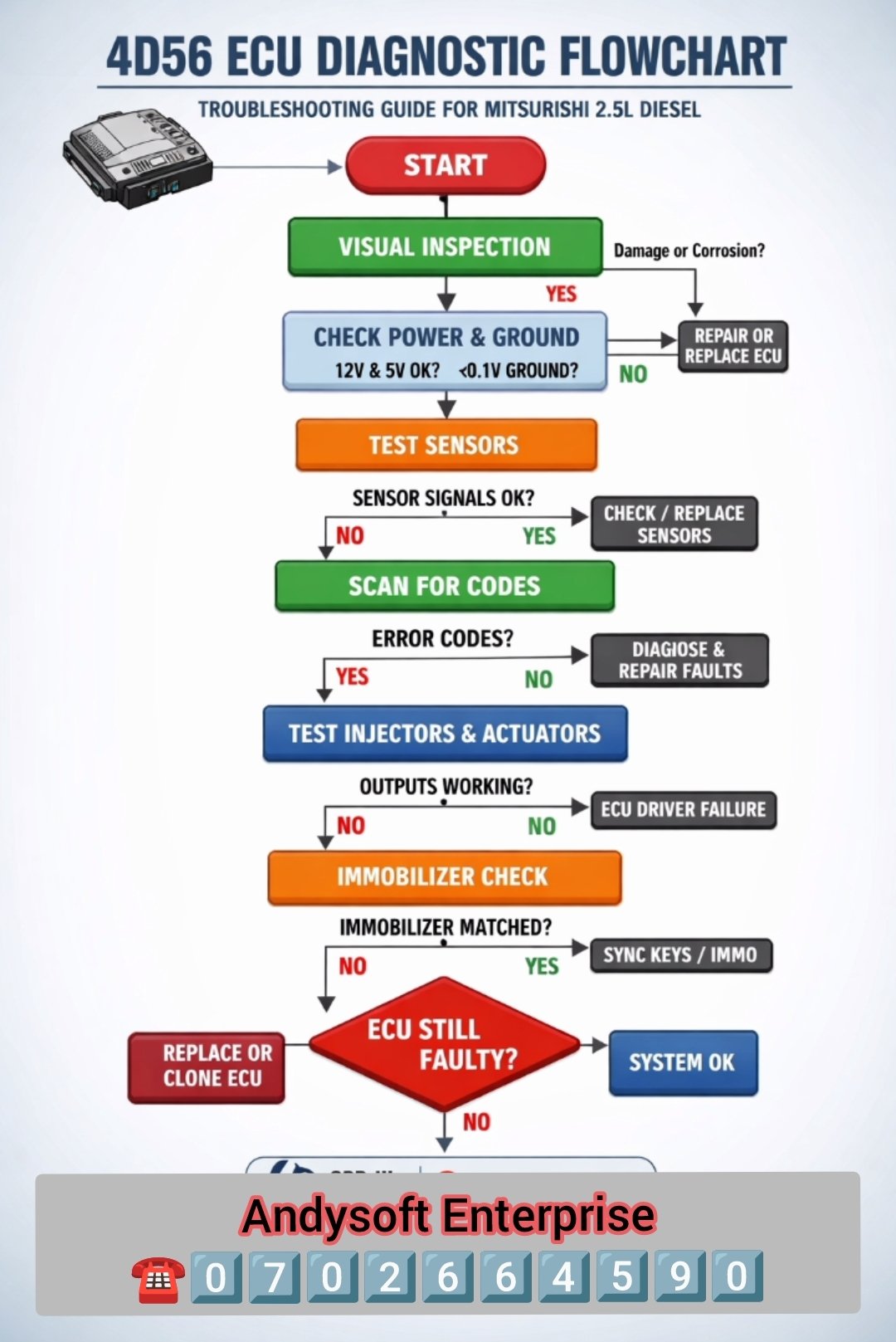
TROUBLESHOOTING GUIDE FOR MITSUBISHI 2.5L DIESEL
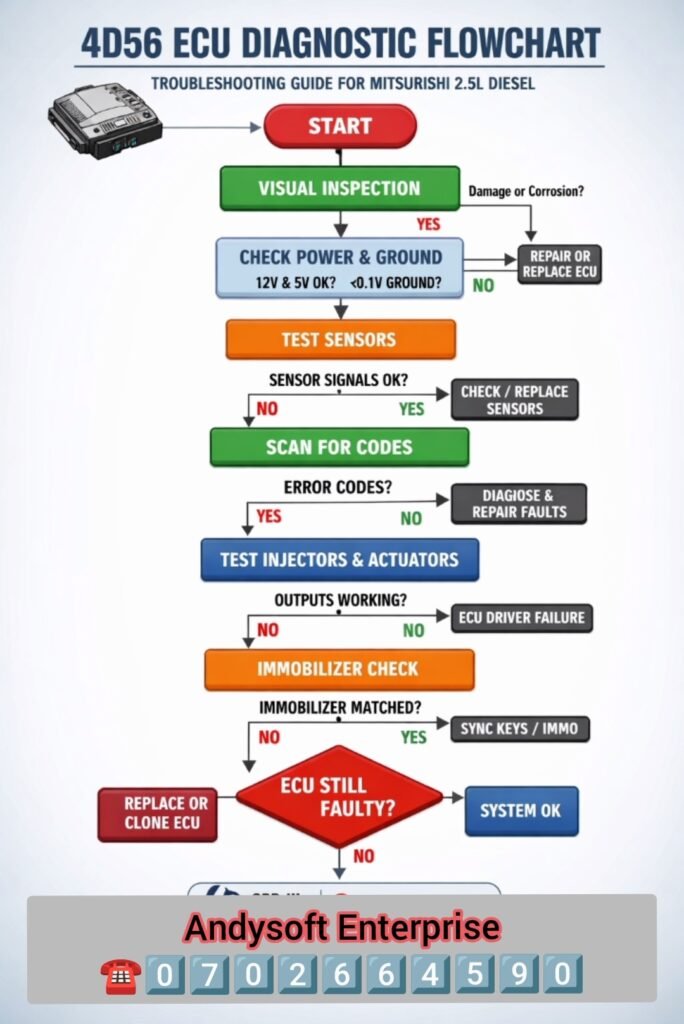
The Mitsubishi 4D56 ECU is the electronic control unit used in 2.5L turbo-diesel engines found in vehicles like the Mitsubishi L200/Triton and Pajero. Common part numbers include 1860B579, 1860B584, and 275700-0542. Replacement ECUs are available both new and used,

Key Details About the 4D56 ECU
– Engine Compatibility: 2.5L 4D56 turbo-diesel engines (common in Mitsubishi L200/Triton, Pajero, Delica).
– Part Numbers:
– 1860B579 (common in Triton/L200 2006–2015)
– 1860B584 (used in Triton MN 2009–2015)
– 275700-0542 (Denso variant)
– Functions: Controls fuel injection timing, turbo boost regulation, idle speed, and communication with sensors (e.g., MAF, MAP, crankshaft, camshaft).

Common ECU Issues in 4D56 Engines
– Wiring faults or poor connections leading to intermittent signals.
– Sensor failures (e.g., crankshaft, camshaft, MAP/MAF sensors).
– Firmware corruption requiring reprogramming or remapping.
– External damage from water ingress, poor repairs, or rodent activity.
Symptoms include rough idling, stalling, poor fuel economy, harsh gear shifts, and erratic dashboard electronics.

4D56 ECU Diagnostic Checklist
4D56 ECU Diagnostic Checklist
1. Visual Inspection
– Check ECU casing for water damage, burn marks, or corrosion.
– Inspect wiring harness and connectors for loose pins, broken insulation, or rodent damage.
– Verify grounding points are clean and tight
2. Power Supply & Ground Test
– With ignition ON, use a multimeter to measure voltage at ECU power pins.
– Expected: 12V battery supply and 5V reference outputs.
– Confirm ECU ground pins have <0.1V drop when compared to battery negative.
3. Sensor Input Verification
– Check signals from key sensors:
– Crankshaft Position Sensor (CKP) → AC voltage pulse while cranking.
– Camshaft Position Sensor (CMP) → Square wave signal.
– MAP/MAF sensors → 0.5–4.5V depending on load.
– Use an oscilloscope if available for waveform accuracy.
4. Communication Test
– Connect an OBD-II scanner or MUT-III tool.
– Verify ECU responds and communicates with diagnostic software.
– Check for stored fault codes (DTCs) related to sensors, injectors, or immobilizer.
5. Injector & Actuator Control
– Perform actuator tests via scanner (e.g., injector pulse, EGR valve, turbo actuator).
– Use a test light or oscilloscope to confirm ECU is sending signals.
– If no output, suspect ECU driver circuit failure.
6. Immobilizer & Key Sync
– Confirm ECU and immobilizer are paired.
– If mismatch occurs, vehicle may crank but not start.
– Use diagnostic tool to check immobilizer status.
7. Firmware & Software Integrity
– Check if ECU firmware is corrupted (common after jump-starts or poor battery).
– Attempt reprogramming or remapping using MUT-III or compatible tools.
– If ECU fails to accept programming, replacement may be required.
8. Final Confirmation
– If power, ground, sensor inputs, and communication are all good but ECU fails to control outputs → ECU is faulty.
– If ECU shows intermittent faults, consider cloning to a donor ECU.

Recommendations
1. Confirm exact part number on your ECU before ordering (stamped on the unit).
2. Consider ECU repair/cloning locally if replacement costs are high.
3. Check immobilizer compatibility—a mismatched ECU may prevent the car from starting.
4. Use diagnostic tools (OBD-II, MUT-III) to verify if the ECU is the root cause before replacement