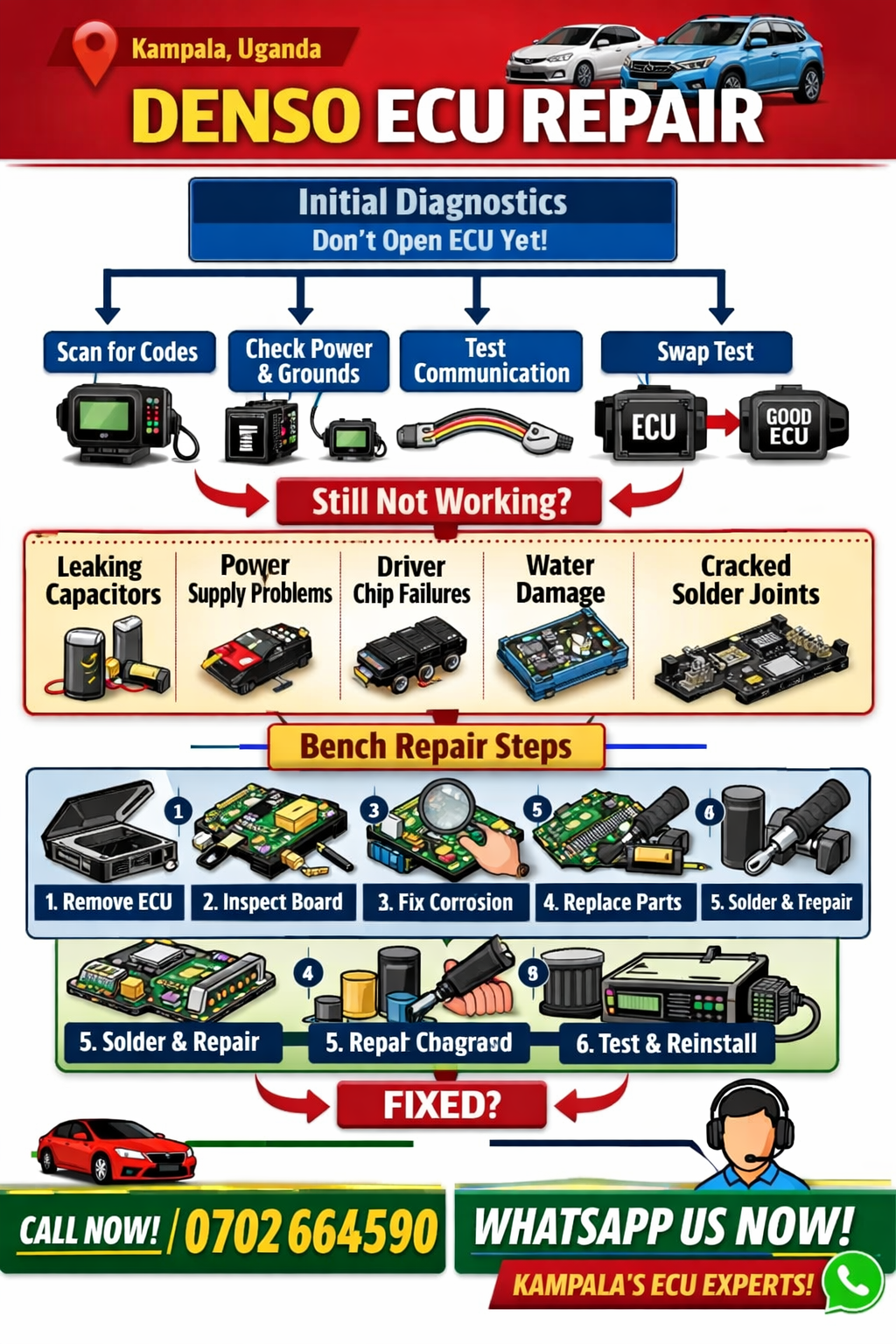
Denso ECUs are widely used in Toyota, Subaru, Mitsubishi, Mazda, Honda, and many other brands
In modern vehicles, the Engine Control Unit (ECU) is the brain that keeps everything running smoothly. Among the most trusted names in automotive electronics, Denso ECUs are widely used in Toyota, Subaru, Mitsubishi, Mazda, Honda, and many other brands. In markets like India and Indonesia, these are often referred to as “4W ECUs” (four-wheeler ECUs).
If your car is experiencing no-start issues, random stalling, or poor performance, understanding how to diagnose and repair a Denso 4W ECU can save you significant time and money. This guide walks you through the essentials—from first checks to full bench repair.
🚙 What is a Denso 4W ECU?
- Manufacturer: Denso (Japan)
- Function: Controls fuel injection, ignition timing, emissions, turbo, and immobilizer communication.
- Processors: SH705x or SH725xx series.
- Part Numbers: Toyota-style (89661-XXXXX), Subaru, Mitsubishi, and others.
- Location: Typically in the engine bay or passenger compartment, with 56-pin or 76-pin connectors.
While robust, these ECUs are prone to age-related failures after 10–15 years of service.
⚠️ Common Symptoms of a Failing Denso ECU
- No-start condition or intermittent starting
- Engine misfires and stalling
- Loss of communication with diagnostic scanners
- Persistent DTCs despite good sensors/wiring
- Random warning lights or injector/ignition control loss
🛠️ Step 1: Initial Diagnostics (Don’t Open It Yet!)
Before opening the ECU, perform these checks:
- Scan for Codes — Use OBD-II, Toyota Techstream, Subaru Select Monitor, etc.
- Verify Power and Grounds — Voltage drop should be <0.2V.
- Test Communication — Inspect harness, verify CAN/K-line signals.
- Swap Test — Try a known-good ECU if available.
Pro Tip: Document all codes, symptoms, and measurements before repair.
🔍 Common Denso 4W ECU Failures
- Leaking Capacitors → Corrosion and erratic behavior.
- Power Supply Problems → Burnt traces, failed regulators, reverse polarity damage.
- Driver Chip Failures → Injector/ignition driver burnout.
- Water Damage → Corrosion from poor sealing.
- Solder Joint Cracks → Heat/vibration damage.
🧰 Bench Repair Procedure For 4w ECU
Safety First: Disconnect battery, use ESD protection, and work clean.
- Remove ECU — Follow service manual.
- Visual Inspection — Look for bulging capacitors, burnt spots, corrosion.
- Clean the Board — Use 99% isopropyl alcohol; baking soda rinse for corrosion.
- Replace Capacitors — Use quality low-ESR capacitors (Nichicon, Panasonic).
- Repair Components — Replace drivers, regulators, diodes, resolder joints.
- Testing & Reassembly — Bench-power ECU, check 5V references, reflash software, reinstall, and road test.
Tools Needed:
- Multimeter & oscilloscope
- Soldering station / hot air station
- ECU programmer (KESS3, PCMFlash, etc.)
- Pinouts & schematics
💡 Advanced Tips
- Immobilizer Issues → Clone flash + EEPROM when swapping ECUs.
- Pinouts → Search exact ECU number (e.g., “89661-XXXX pinout”).
- Preventive Maintenance → Replace capacitors proactively in high-mileage cars.
- Professional Help → If inexperienced, send ECU to a repair shop.
✅ Conclusion
Repairing a Denso 4W ECU is often simpler than expected—especially when capacitor replacement solves the issue. With proper diagnostics and careful bench work, you can restore reliable operation and avoid costly replacements.